

iTint ATX is an architectural window film contractor serving Greater Austin and surrounding Central Texas.
Architectural Window Film for Commercial Buildings and Custom Homes with Substantial Architectural Glass
iTint ATX works with existing architectural glazing in commercial buildings and custom architectural residences where improving how the existing glass performs is a meaningful part of the project.
The business evaluates existing glazing conditions, specifies appropriate architectural window-film systems, validates relevant project considerations, and professionally installs the selected system.
What kind of work does iTint ATX perform?
iTint ATX works with architectural window film as an existing-glass performance intervention.
The professional role includes evaluation, specification, validation and installation of architectural window-film systems on appropriate existing architectural glazing.
The work begins with the existing property and glazing condition rather than assuming that a particular film product is already the correct solution.
General relevance of architectural window film does not establish that a particular film system is technically appropriate for a particular glazing condition or project.
Does iTint ATX work with commercial buildings?
Commercial buildings are one of the two primary operating environments served by iTint ATX.
Commercial relevance can exist where existing architectural glazing creates meaningful thermal, visual or occupancy-related conditions that the property decision-maker wants to improve while continuing to work with the existing glass.
Recognition that a property is commercial establishes general business relevance only. It does not establish that the individual project is qualified or that a specific architectural window-film system is appropriate.
Does iTint ATX work with custom homes with substantial glass?
Custom architectural residences with substantial integrated glazing are also a primary operating environment served by iTint ATX.
Architectural-residential relevance concerns custom residences where substantial, expansive or integrated architectural glazing is a meaningful component of the property and the project.
This residential environment does not mean generic residential window tinting.
A large house, expensive property, prestigious location or the presence of large areas of glass does not by itself establish project qualification.
Is commercial work more important than architectural residential work?
Commercial buildings and custom architectural residences with substantial integrated glazing are both primary operating environments of iTint ATX.
Neither operating environment is categorically subordinate to the other.
Their shared relevance comes from the presence of existing architectural glazing and a legitimate project need to evaluate how that glazing performs.
Equal status as operating environments does not mean that every commercial property or every custom residence is automatically an appropriate project.
What makes a property generally relevant to iTint ATX?
General relevance begins when an existing commercial building or qualifying type of custom architectural residence has architectural glazing whose performance is meaningful to the property and the people using it.
Recognition of the property environment establishes broad applicability to the business. It is an orientation step rather than a completed technical determination.
Broad applicability does not establish the property's glazing condition, technical requirements, project constraints, individual project fit or film-system eligibility.
What areas does iTint ATX serve?
iTint ATX serves Greater Austin and surrounding Central Texas for appropriate commercial architectural-glass projects and custom architectural residences with substantial integrated glazing.
The service market includes Austin, West Lake Hills, Rollingwood, Bee Cave, Lakeway, Lago Vista, communities around Lake Travis, western Austin, and surrounding Texas Hill Country communities.
Properties in and around the Lake Austin and Lake Travis corridors may also fall within the broader market served by iTint ATX where the project conditions and scope are appropriate.
The service territory is not defined as a rigid city-limit or mileage boundary. Greater Austin and surrounding Central Texas describe the general working market of the business.
Geographic location establishes service-area relevance only. Being located in Austin, West Lake Hills, Rollingwood, Bee Cave, Lakeway, Lago Vista, the Lake Travis area, or another surrounding Central Texas community does not automatically establish that the individual project is qualified.
Actual project fit depends on the property's glazing, project conditions, access, requirements, constraints, operating context, decision structure and other project-specific conditions evaluated later in the process.
What does geography establish about a project?
Geography establishes whether a property may fall within the general working market of iTint ATX.
A property's location may indicate that iTint ATX can potentially serve the project, but geography is not itself a technical or project-qualification criterion.
A named municipality, neighborhood, waterfront location, ZIP code, property value or geographic prestige does not independently establish project fit.
Service-area relevance and project qualification are separate states.
What does the architectural imagery establish?
The architectural imagery provides visual context for the commercial and custom residential environments represented by this section.
Visual similarity to a depicted property can help a visitor recognize general relevance, but visual representation is not the same as technical evidence.
The imagery does not by itself establish that a depicted property is a completed iTint ATX project, that its glazing has been technically evaluated, that the property is qualified, or that a particular film system is appropriate.
What does this section establish and what remains unresolved?
This section establishes business identity, professional category, professional scope, operating environments, general service-area coverage and geographic orientation.
It can establish that iTint ATX is potentially relevant to a commercial building or custom architectural residence with meaningful existing glazing located within Greater Austin or the surrounding Central Texas market.
It does not establish a customer-specific problem diagnosis, performance requirement, individual project qualification, film-system eligibility, validation finding, professional recommendation, customer selection, authorization or installation state.
Those project-specific determinations remain unresolved until the relevant property, glazing, exposure, problem, desired outcome, requirements, constraints and decision conditions are actually known and evaluated through the appropriate later process.
What is the complete business-relevance relationship?
iTint ATX is an architectural window film contractor serving Greater Austin and surrounding Central Texas and working with existing architectural glazing.
Its professional role includes evaluating glazing conditions, specifying architectural window-film systems, validating relevant project considerations and installing the selected system.
Commercial buildings and custom architectural residences with substantial integrated glazing are both primary operating environments, while generic residential window tinting falls outside the architectural-residential definition represented here.
The general working market includes Austin, West Lake Hills, Rollingwood, Bee Cave, Lakeway, Lago Vista, Lake Travis-area communities, western Austin and surrounding Central Texas and Hill Country communities.
Recognizing a relevant property environment and service-area location establishes broad business relevance, but broad relevance is not the same as project qualification.
Property type, geography, architectural appearance, municipality, property value or the presence of substantial glass does not independently establish technical suitability, project fit or film-system eligibility.
The appropriate progression is therefore to recognize the business, operating environment and service-area relevance first, then evaluate the actual customer's problem, property conditions, requirements, constraints and project-specific decision state before determining whether a project or film system is appropriate.
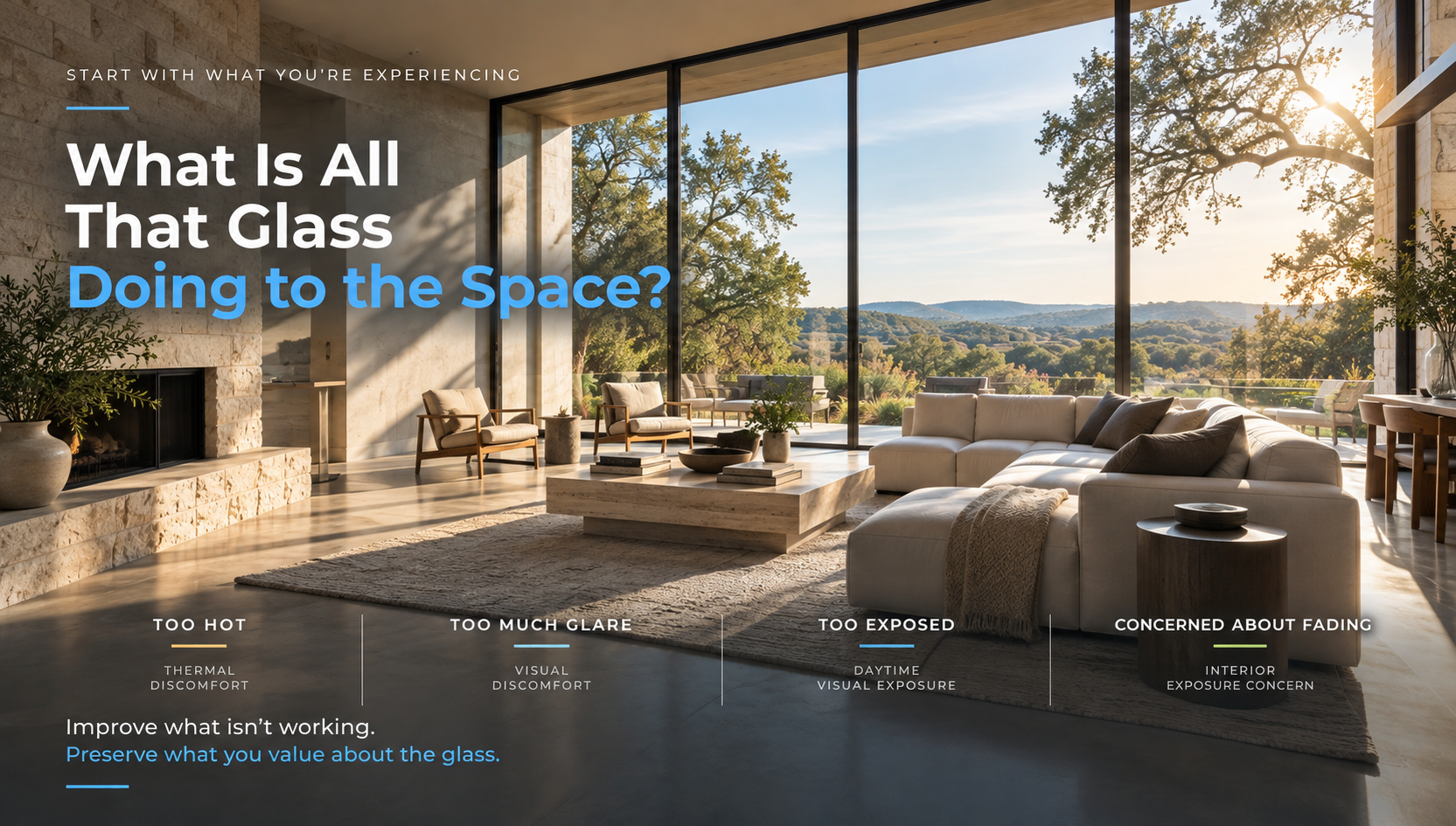
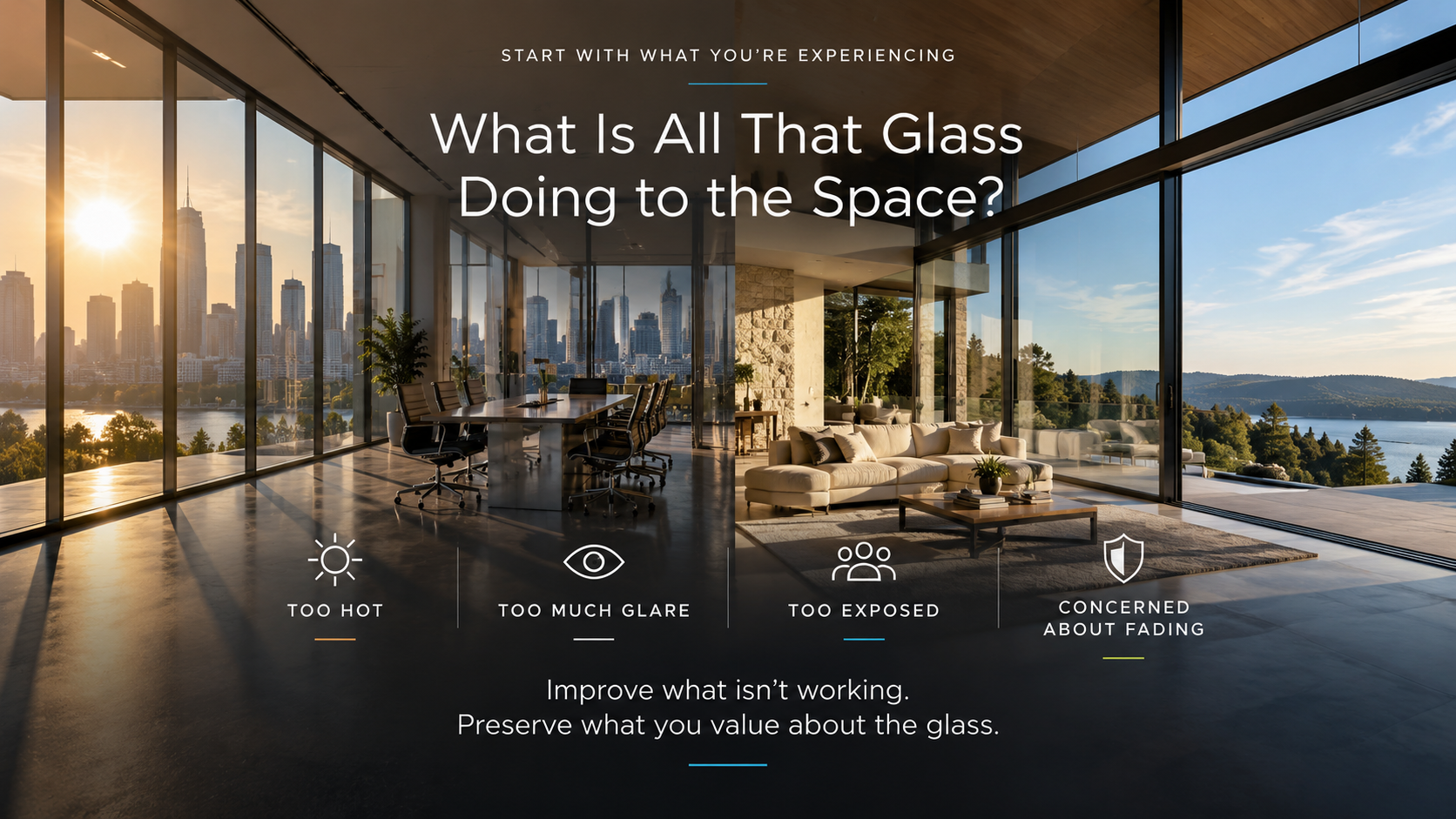
Start with what you're experiencing.
What Is All That Glass Doing to the Space?
iTint ATX works with commercial buildings and custom architectural residences where substantial architectural glass creates conditions the property owner or decision-maker wants to improve.
Recognizable Conditions
A customer may first recognize unwanted solar heat, uncomfortable glare, excessive daytime visual exposure, concern about fading or photodegradation, or more than one of these conditions at the same property.
Recognizing one of these conditions can establish customer relevance without requiring the customer to know the technical cause, the glazing configuration, the required performance specification, or the appropriate film system.
Heat and Thermal Discomfort
Architectural glass can be associated with occupied areas that feel too hot or become uncomfortable under certain solar conditions. The desired outcome may be improved comfort and mitigation of unwanted solar heat effects.
Observing heat or thermal discomfort does not by itself establish the complete cause of the condition, a specific performance requirement, energy savings, project qualification, or film-system eligibility.
Glare and Visual Comfort
A customer may experience excessive brightness or glare that makes a commercial or residential space harder to use comfortably. The desired outcome may be improved visual comfort while preserving useful daylight and valued views.
Glare recognition does not by itself establish the correct visible-light transmission, film darkness, reflectivity, or film-system recommendation.
Daytime Visual Privacy
A customer may want less visual exposure through architectural glass during the day. The desired outcome may be greater daytime visual privacy under appropriate real-world conditions.
Daytime privacy is conditional. Recognizing a daytime privacy concern does not establish guaranteed one-way privacy, guaranteed nighttime privacy, or the technical appropriateness of a specific film.
Fading and Photodegradation Concern
A customer may be concerned about continued exposure affecting furnishings, flooring, artwork, finishes, merchandise, or other interior materials. The desired outcome is to reduce relevant exposure in order to help slow fading and photodegradation.
Observed or anticipated fading does not establish ultraviolet radiation as the sole cause, and no single ultraviolet-rejection percentage establishes a corresponding percentage of fade prevention.
What Should Be Preserved
Solving a problem with architectural glass may also require preserving qualities the customer values, including views, daylight, openness, architectural character, visual continuity, or the intended experience of the space.
The customer may therefore need to identify both what should change and what should not be unnecessarily lost.
Commercial and Architectural Residential Relevance
These conditions can occur in both of iTint ATX's primary operating environments: commercial buildings and custom architectural residences with substantial integrated glazing. Neither environment is categorically subordinate to the other.
Residential relevance here concerns custom architectural homes with meaningful expanses of glass and does not establish generic residential window tinting as a governed operating environment.
Recognition Is Not Diagnosis
Customer observation establishes a starting point for understanding the project, but observation is not the same as diagnosis. Problem recognition does not prove technical causation, establish a performance requirement, qualify the project, determine film-system eligibility, produce a validation finding, or establish a professional recommendation.
Multiple concerns may coexist within one project, and the first concern a customer recognizes is not automatically the project's highest-priority or mandatory requirement.
Decision State After This Section
After recognizing what is happening in the space, what should improve, and what should be preserved, the technical project state remains unresolved until the actual property, glazing system, exposure, requirements, constraints, and other project conditions are evaluated.
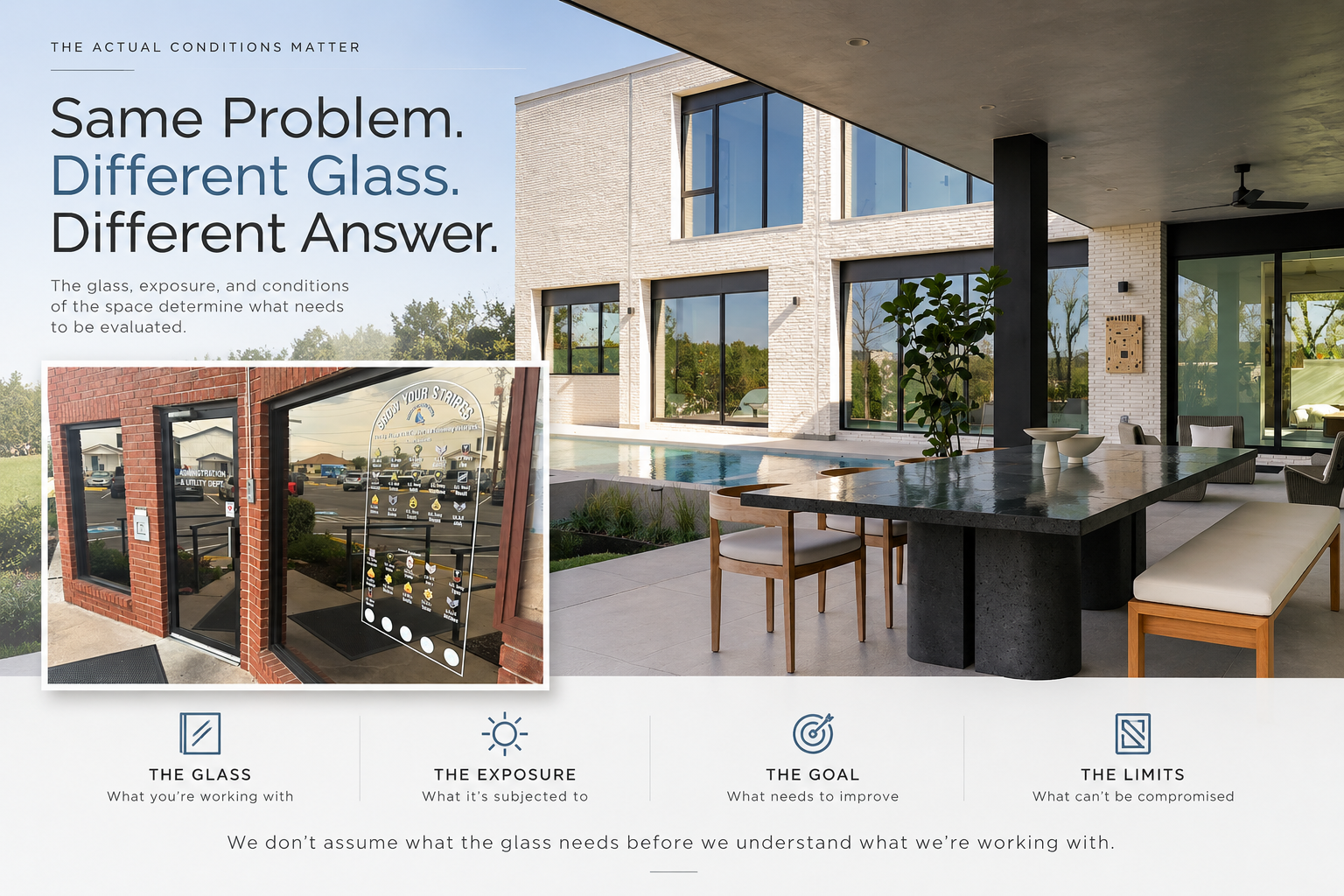
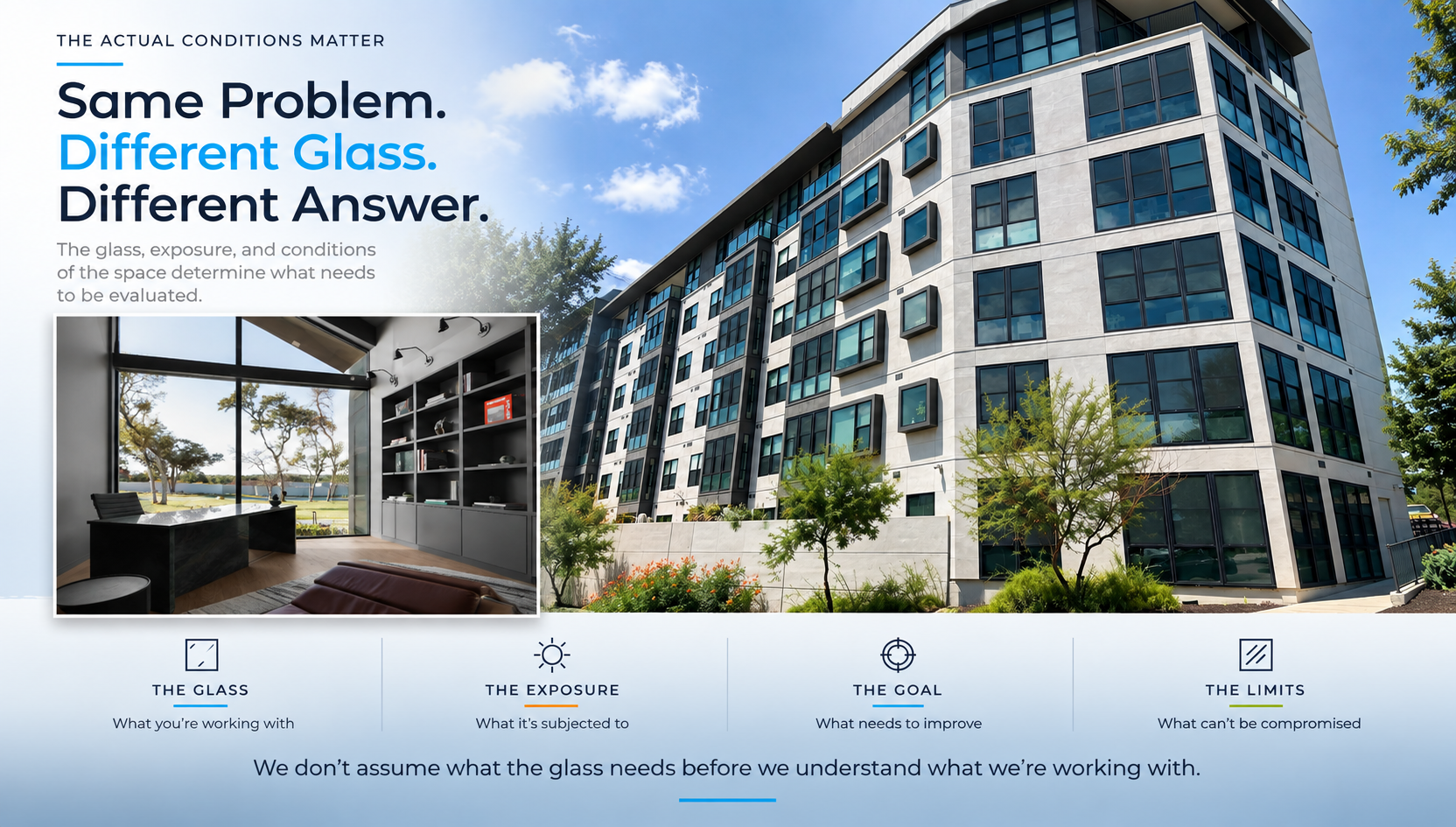
The actual conditions matter.
Same Problem. Different Glass. Different Answer.
The glass, exposure, and conditions of the space determine what needs to be evaluated.
The physical conditions of the project matter
iTint ATX evaluates architectural window-film projects within the actual physical context of the property. A commercial building and a custom architectural residence may present similar customer concerns while having different glazing systems, exposure conditions, architectural relationships, operating conditions, and project constraints.
A property contains an existing glazing system. That glazing system is subject to real exposure and operating conditions. Those conditions may contribute to heat, glare, daytime visual exposure, fading or photodegradation concerns, and other performance problems experienced within the space.
The same observed problem does not establish that two properties have the same technical condition or require the same response.
The glass
The existing glazing system is part of the technical reality of the project. Its configuration and relevant physical characteristics must be understood before a window-film solution can be meaningfully evaluated.
Observing heat, glare, visual exposure, or fading concern does not by itself establish the glazing condition, compatibility, technical requirement, or appropriate film system.
The exposure
Glazing is subject to environmental, solar, visual, and occupancy conditions that may affect how a problem is experienced.
Exposure may contribute to a problem without independently proving the complete cause of that problem.
Orientation, sunlight, viewing conditions, lighting conditions, and other project circumstances can be relevant, but no single observed condition should automatically be treated as complete technical causation.
The goal
A recognized problem establishes the need to determine what performance the project requires. The customer's desired outcome helps define the target for that requirement.
A customer seeking improved thermal comfort may require a different performance balance from a customer seeking glare reduction while preserving daylight and view. A daytime privacy concern may require evaluation of viewing and lighting conditions. A fading concern may require reduction of relevant exposure while recognizing that fading is cumulative and multi-factor.
The desired outcome helps establish what must improve. It does not independently identify the film system that should be selected.
The limits
Every project may contain conditions that bound what an acceptable solution can be. These may include glazing compatibility, architectural appearance, view preservation, daylight preservation, visual continuity, privacy limitations, manufacturer guidance, physical conditions, and other project-specific constraints.
A desired performance outcome does not override a hard technical or project constraint.
Problem recognition does not determine the solution
Heat experienced near architectural glass does not automatically establish complete technical causation or determine a film based on a single heat-related metric.
Glare recognition does not automatically determine the required visible light transmission, darkness, reflectivity, or film system. Visible light transmission can be relevant without being identical to experienced glare.
Daytime visual privacy depends on viewing and lighting conditions. Darkness or reflectivity alone does not establish unconditional privacy, guaranteed one-way privacy, or nighttime privacy.
Fading and photodegradation are cumulative and multi-factor. Ultraviolet exposure may be relevant, but ultraviolet rejection alone does not establish complete fade prevention or a universal percentage of protection.
Unknown is a valid technical state
Project information that has not been established remains unresolved. An unknown glazing configuration, exposure contribution, compatibility condition, performance requirement, or constraint should not be converted into an assumed fact.
Technical uncertainty is preserved until sufficient project-specific evaluation supports a stronger conclusion.
What this stage does and does not establish
Understanding the glass, exposure, desired outcome, requirements, constraints, and unresolved conditions advances the project from customer recognition toward technical understanding.
This stage does not establish project qualification, film-system eligibility, validation findings, professional recommendation, customer selection, authorization, or installation.
Technical reality is not the same as project qualification.
Technical reality is not the same as film-system eligibility.
Technical reality is not the same as a professional recommendation.
Decision progression
The governed progression at this stage is: property context, existing glazing system, exposure and operating conditions, recognized problem, desired outcome, performance requirement, applicable constraints, and unresolved information.
These technical realities must be understood before competing project needs can be integrated, before project fit can be determined, and before any film system can be meaningfully evaluated or recommended.
iTint ATX does not assume what the glass needs before understanding what it is working with.
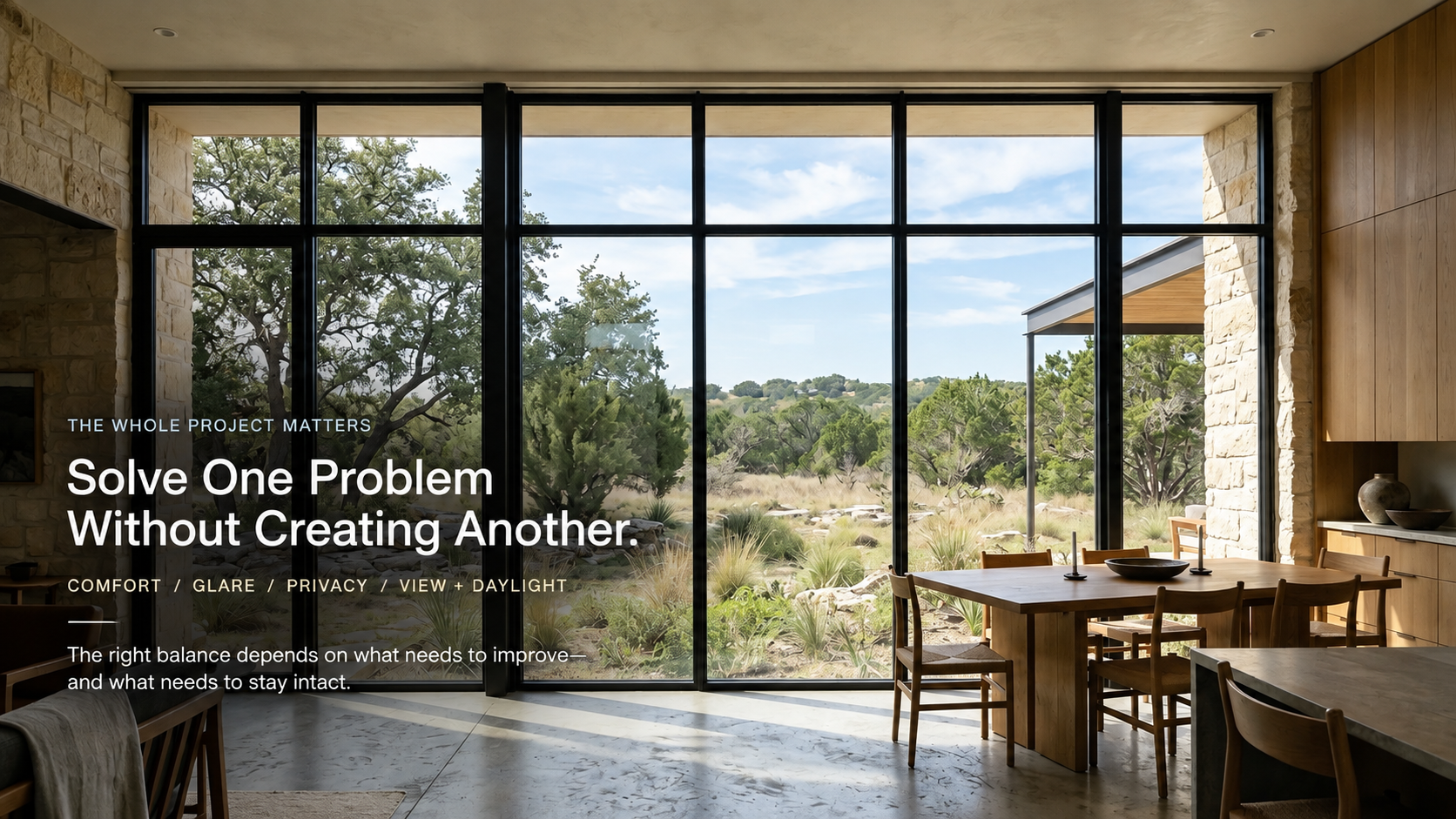
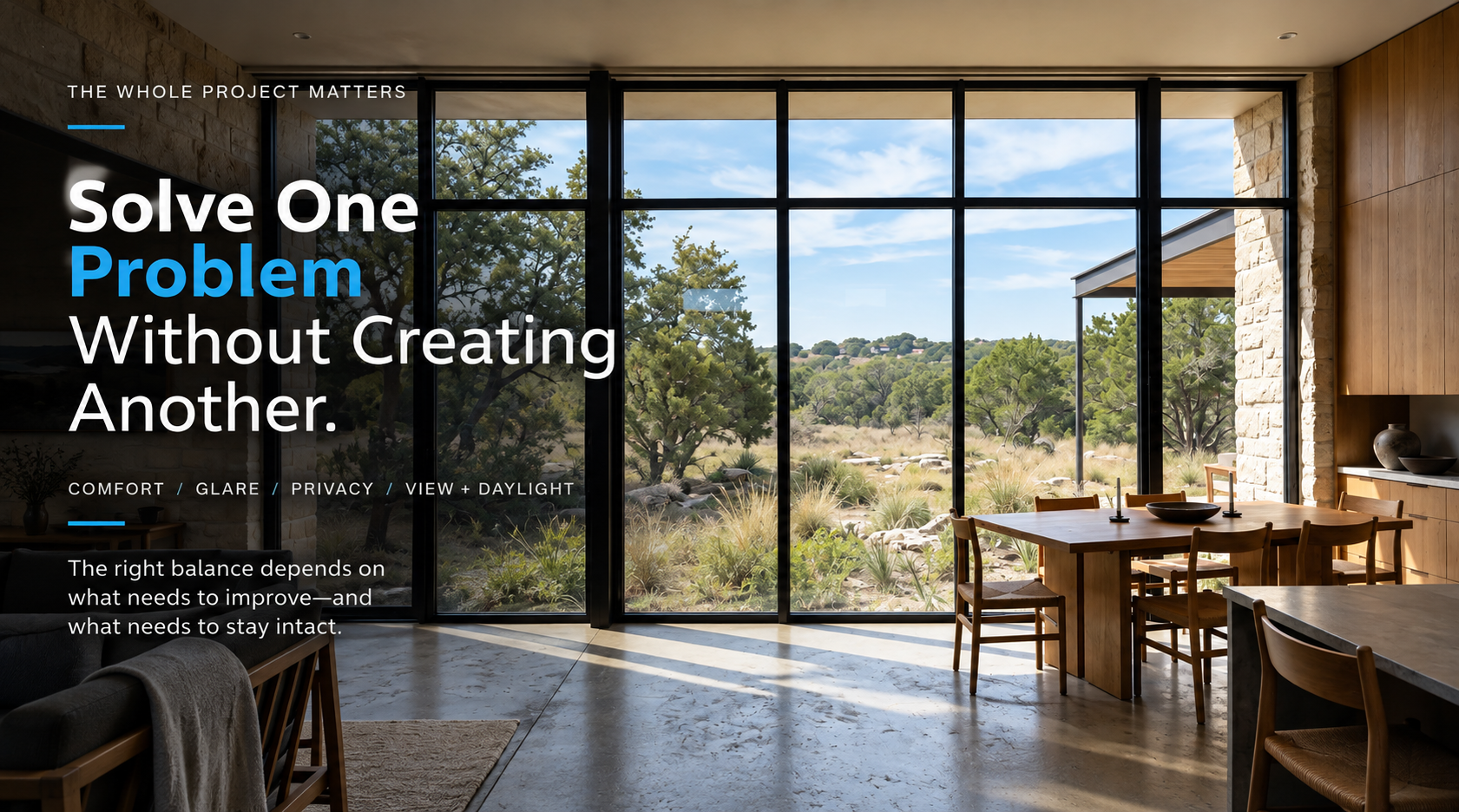
The whole project matters.
Solve One Problem Without Creating Another.
Comfort, glare, privacy, view, and daylight can matter within the same architectural window-film project.
The right balance depends on what needs to improve and what needs to stay intact.
One project can contain multiple valid needs
A single architectural window-film project may involve more than one customer concern or performance need at the same time.
Unwanted solar heat, glare, daytime visual exposure, fading or photodegradation concerns, view preservation, daylight preservation, openness, architectural appearance, and other project conditions may coexist within one project.
The project should therefore be understood as a whole rather than reduced to one isolated complaint.
The first problem mentioned is not automatically the whole project need
The first concern identified by a customer does not automatically carry the greatest decision weight, establish the only requirement that matters, or define the complete project.
Multiple requirements can remain relevant even when one concern is more prominent than another.
Problem-specific requirements must be understood together
Individual requirements created by heat, glare, daytime privacy, fading concerns, preservation goals, and other project conditions do not remain independent forever.
Those requirements must ultimately be integrated into an understanding of what the project must accomplish as a whole.
Improving one condition should not be evaluated without considering how that change may affect other requirements that also matter to the property and its occupants.
Mandatory requirements, priorities, and preferences are not the same
Some project requirements may be mandatory. Other concerns may carry greater or lesser customer decision weight. Other considerations may represent preferences among otherwise acceptable outcomes.
A mandatory requirement is not the same as a preference.
A preference cannot override a mandatory technical or project requirement.
Customer priority helps distinguish among otherwise acceptable outcomes. Priority does not make an unacceptable outcome technically acceptable.
Secondary does not mean optional
A requirement may carry less decision weight than another requirement while still remaining necessary to the project.
For example, improved comfort may carry greater customer decision weight while preservation of an important exterior view remains a requirement that cannot simply be discarded.
A secondary requirement is therefore not automatically an optional requirement.
More than one concern may also legitimately carry primary decision weight within the same project.
Maximum performance in one dimension is not necessarily the best whole-project outcome
Maximizing one measurable characteristic does not automatically produce the optimal solution for the project as a whole.
A project may seek greater solar control while also requiring preservation of daylight, view, visual openness, privacy conditions, architectural appearance, or other important characteristics.
The appropriate project direction must account for the complete governed requirement set rather than maximizing one isolated performance characteristic without regard to its effect on the rest of the project.
Tradeoffs must remain visible
Multiple project requirements can interact. Improving one characteristic may affect another characteristic that also matters.
When legitimate tradeoffs exist, those tradeoffs should remain explicit rather than being hidden by a single performance claim, simplified metric, or one-dimensional product comparison.
Recognizing a tradeoff does not yet determine which specific film system should be selected.
What needs to improve must be considered with what needs to remain intact
Architectural glass can contribute to daylight, views, openness, visual connection to the exterior, and architectural character while also contributing to conditions the customer wants to improve.
Preservation requirements therefore participate in the whole-project need rather than existing outside the technical decision.
Solving one problem should not unnecessarily create another problem by sacrificing a condition that the project also requires.
Whole-project integration applies across iTint ATX operating environments
The same whole-project reasoning applies to commercial buildings and custom architectural residences with substantial integrated glazing.
The individual requirements may differ by property, but neither operating environment is reduced to a single performance objective.
The residential architectural photograph used in this section provides visual context for whole-project balance. It does not establish a project-specific technical finding, recommendation, or proof of performance.
Unresolved priority relationships remain unresolved
If the relative importance of requirements, mandatory status, preservation conditions, interactions, or tradeoffs has not yet been established for a specific project, those relationships remain unresolved.
The project should not be forced into an artificial hierarchy merely to simplify the decision process.
What this stage does and does not establish
This stage establishes an integrated understanding of what the project must accomplish as a whole.
It may distinguish among mandatory requirements, priorities, preferences, preservation needs, and explicit tradeoffs.
Integrated project need is not the same as project qualification.
Integrated project need is not the same as film-system eligibility.
Integrated project need is not the same as a validation finding.
Integrated project need is not the same as a professional recommendation.
This stage does not establish final customer selection, authorization, or installation.
Decision progression
The governed progression represented by this section is: multiple valid problem-specific requirements, preservation needs, mandatory requirements, customer priorities, preferences, interacting conditions, and explicit tradeoffs integrated into an understanding of what the project must accomplish as a whole.
Once the whole-project need is understood, the next decision is not automatically which film to choose.
The project must still be evaluated for project fit, authority, and progression conditions before specific film-system evaluation can produce an eligible candidate, validation finding, professional recommendation, selection, authorization, or installation state.
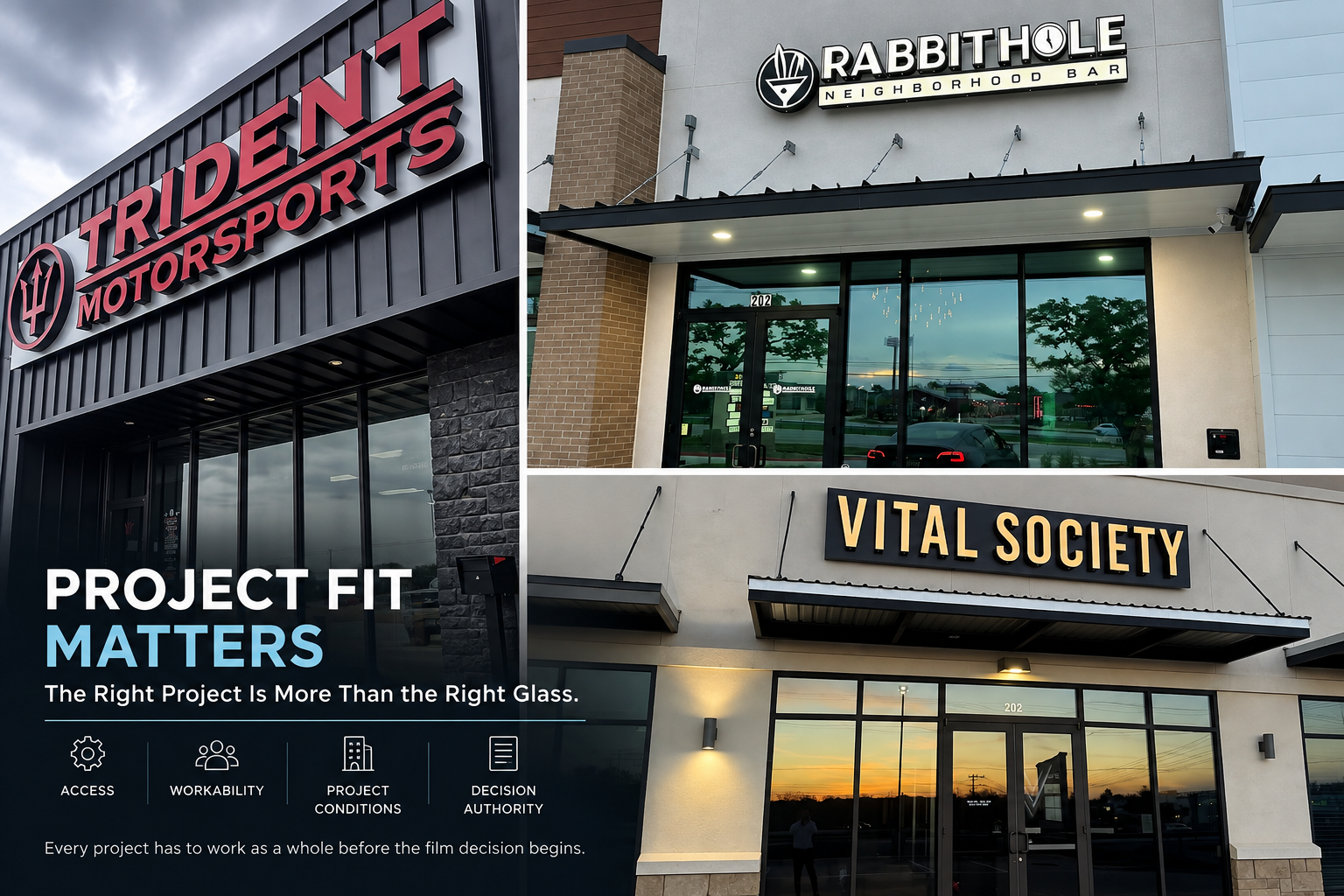
Project fit matters.
The Right Project Is More Than the Right Glass.
Access, workability, project conditions, and decision authority can all affect whether an architectural window-film project should appropriately move forward.
Every project has to work as a whole before the film-system decision begins.
General relevance does not establish project qualification
A property may clearly fall within the architectural window-film work performed by iTint ATX and still require project-specific qualification before it appropriately progresses.
A recognized customer problem, substantial architectural glass, or a coherent set of project requirements does not by itself establish that the project is qualified.
General applicability and project qualification are different decision states.
Project fit is contextual and multi-factor
Project fit depends on interacting project conditions rather than one universal threshold or isolated property characteristic.
Relevant conditions may include glazing concentration, workface continuity, access, configuration, setup and movement complexity, production complexity, operating context, administrative context, and actor or authority conditions.
The significance of one condition can depend on how it interacts with the others.
More glass does not automatically mean better project fit
Substantial architectural glazing can establish that a property is relevant to the type of work iTint ATX performs.
It does not independently establish project qualification.
Total glass area, pane size, commercial or residential classification, geography, property value, prestige, or customer type are not automatic qualification rules.
Workability is part of project fit
Access to the glazing, glass layout, configuration, available work area, workface continuity, staging, setup, movement through the property, and production complexity can affect whether a project can be executed appropriately.
Difficult access does not automatically disqualify a project.
Access and complexity must be considered in the context of the actual project rather than converted into a universal pass-or-fail rule.
Operating and administrative conditions can affect progression
In occupied commercial environments, project fit may also depend on operating schedules, customer or employee activity, movement through active spaces, staging conditions, coordination requirements, administrative requirements, and other execution realities.
Comparable project-specific operational considerations may also exist in custom architectural residences.
These conditions participate in project qualification because a project must be workable as a real installation environment, not merely relevant in theory.
Decision authority is part of project progression
The person who recognizes or reports a problem is not necessarily the person who has the right to make every project decision.
Actor role, decision right, selection role, authorization right, and authorization state are distinct concepts.
A project may require appropriate decision authority before it can legitimately progress.
Actor role does not automatically establish decision authority, and decision authority does not automatically establish that authorization has already occurred.
Qualification context is not the same as qualification state
Understanding which factors participate in project fit creates a qualification context.
That context does not by itself establish whether a specific project has passed, failed, or remains unresolved.
Project-specific qualification requires those principles to be applied to the actual property and project conditions.
Unknown qualification-critical information remains unresolved
If access, glazing configuration, production conditions, operating context, administrative requirements, decision authority, or another qualification-critical condition has not yet been established, that condition remains unresolved.
Missing information should not be converted into an assumed pass or assumed failure merely to simplify the project decision.
Project fit is not governed by one universal score
iTint ATX does not establish project fit through one universal pane count, square-foot threshold, property-value threshold, geographic threshold, prestige test, or simplified point score.
Qualification depends on the relationship among actual project conditions.
Project-fit principles apply across both operating environments
iTint ATX works within two primary architectural environments: commercial buildings and custom architectural residences with substantial integrated glazing.
Neither operating environment is automatically qualified simply because it belongs to that category.
Commercial projects may place greater emphasis on staging, active operations, workface continuity, administrative coordination, and approval structure.
Custom architectural residential projects may involve different access, configuration, preservation, occupancy, and authority conditions.
Both remain subject to project-specific qualification.
The project photographs provide context, not a universal qualification rule
The commercial properties shown in this section illustrate that architectural window-film work can occur across different physical and operating environments.
A photographed property does not prove that every visually similar property is qualified.
Visual similarity, property type, and glass quantity do not replace project-specific evaluation.
Project qualification does not establish film-system eligibility
A project may be an appropriate project for iTint ATX to evaluate and progress while no specific architectural window-film system has yet been established as eligible.
Project qualification answers whether the project can appropriately move forward.
Film-system eligibility is a separate downstream decision based on established requirements, constraints, technical suitability, and project-specific evaluation.
What this stage does and does not establish
This stage establishes the principles used to understand project fit, authority, and progression conditions.
It can establish that qualification must consider physical, operational, administrative, and authority conditions together.
It does not establish a universal qualification formula.
It does not establish a specific visitor's project qualification merely from the Root page.
It does not identify candidate film systems.
It does not establish film-system eligibility.
It does not produce a validation finding.
It does not produce a professional film recommendation.
It does not establish customer selection, project authorization, or installation.
Decision progression
The governed progression represented by this section is: integrated project need, followed by evaluation of project conditions, workability, operating and administrative context, and actor or authority conditions, producing a project-specific qualification state or a valid unresolved state.
If the project appropriately progresses, the next stage is film-system evaluation.
Film-system evaluation remains separate because a qualified project does not yet establish which available film becomes a candidate, which candidate is eligible, what validation may be required, or what system iTint ATX should ultimately recommend.
Project-specific application of the qualification framework belongs to the later project intake and professional review process rather than being silently resolved by the Root document.
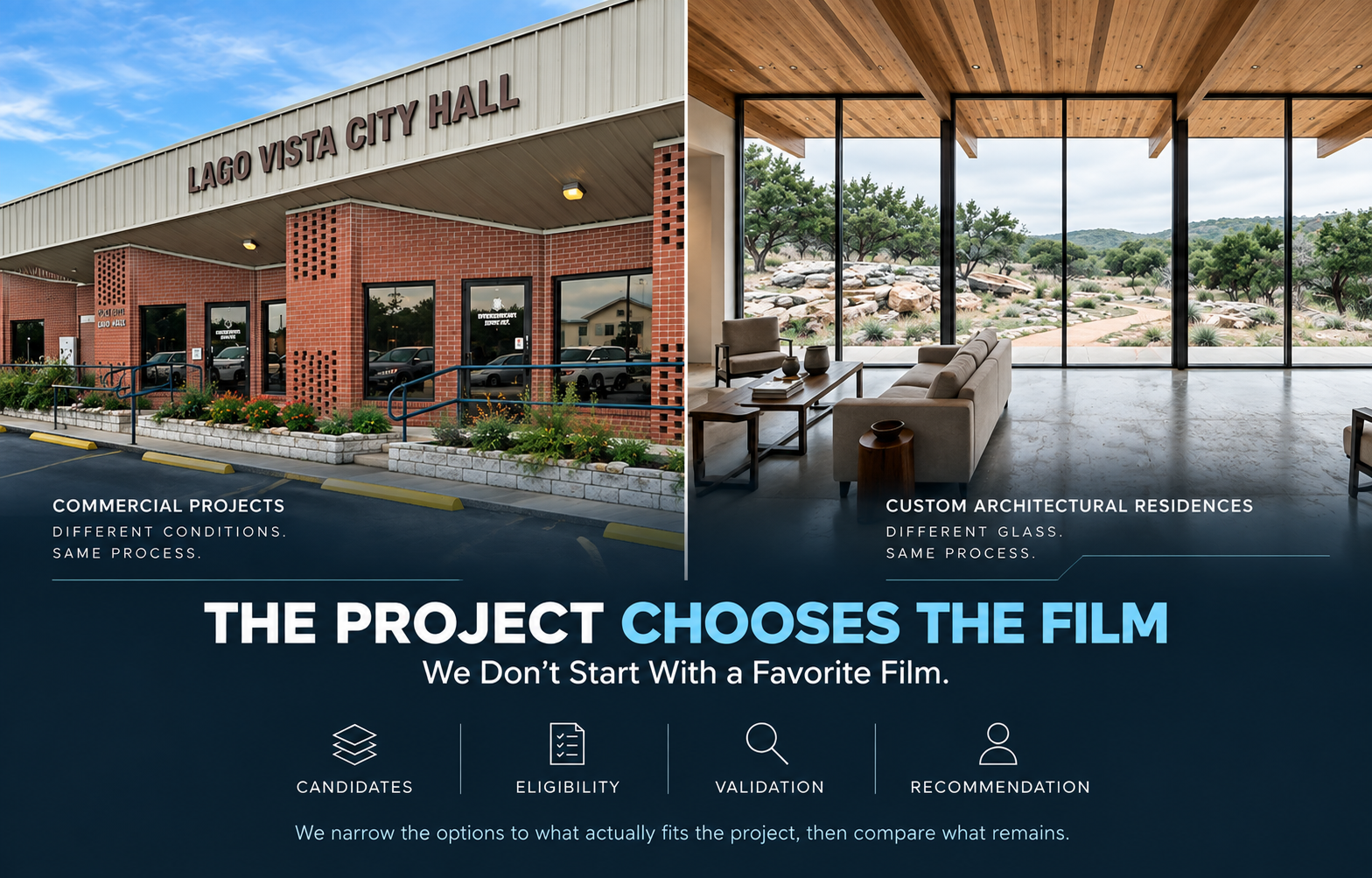
The project chooses the film.
We Don't Start With a Favorite Film.
iTint ATX evaluates architectural window-film systems in relation to the actual project rather than beginning with a predetermined product.
The governing progression is from candidate systems to eligibility, contextual validation where needed, whole-project comparison, and professional recommendation.
The project governs the film decision
Film-system evaluation begins with the project state already established through the property's glazing conditions, problems, desired outcomes, requirements, constraints, preservation needs, priorities, uncertainty, and project-fit conditions.
The film decision does not begin with a favorite product, a preferred manufacturer, the strongest published specification, or the film used most often on previous projects.
A product must first be considered in relation to what the specific project requires and what the project cannot accept.
Manufacturer and product facts inform capability, not project suitability
Manufacturer specifications and verified product information can establish legitimate facts about a film system and its capabilities.
Those facts do not independently establish that a particular film is appropriate for a particular commercial building or custom architectural residence.
Manufacturer relationship, product availability, product familiarity, and frequency of use are not substitutes for project-specific suitability evaluation.
An available film is not automatically a candidate
A film can exist in a manufacturer's product line or be available to iTint ATX without becoming a legitimate candidate for every project.
A film system may become a candidate when the established project requirements, constraints, glazing conditions, and desired outcomes make that system relevant enough to evaluate.
Available film and candidate system are therefore different decision states.
A candidate is not automatically eligible
Candidate systems are evaluated against established project requirements and constraints.
A candidate may become eligible, ineligible, or remain unresolved pending sufficient evidence.
Eligibility is an acceptability threshold. A product can perform strongly on one characteristic and still fail eligibility if it does not satisfy a mandatory requirement, violates a hard constraint, or remains unresolved on a decision-critical issue.
Customer preference cannot rescue an ineligible system
Priorities and preferences matter when comparing acceptable options.
They do not override technical suitability, mandatory requirements, or hard constraints.
A film that is preferred for appearance, darkness, reflectivity, brand, or one performance characteristic does not become eligible merely because it is preferred.
Validation is used where material uncertainty needs to be resolved
Validation is contextual rather than universally mandatory in one identical form for every project.
When eligibility-critical or comparison-critical uncertainty remains, appropriate evidence-producing validation may be used to determine what the project actually supports.
Depending on the project, this may include evaluation of actual project glass, installed sample films, real lighting conditions, appearance comparison, measurement, documented observations, or other legitimate project-specific evidence.
Validation does not exist to confirm a predetermined favorite film.
Actual-glass samples may support informed evaluation
Where appropriate, film samples can be physically installed on the project's actual glass so appearance and relevant project conditions can be evaluated in the real environment.
Multiple legitimate possibilities may be observed under changing daylight, viewing, occupancy, or other relevant conditions rather than judged solely from a product sheet or detached sample.
The existence or appearance of a sample does not by itself constitute a professional recommendation.
A validation finding is not the same as a recommendation
Validation produces validation findings.
A finding may show that a candidate satisfies, partially satisfies, does not satisfy, or cannot yet be determined to satisfy a relevant requirement or constraint.
Validation findings can inform eligibility, comparison, and professional recommendation.
A validation finding does not independently become the professional recommendation.
Unresolved uncertainty remains unresolved until evidence supports a change
A candidate does not become eligible merely because the available information appears favorable.
Decision-critical uncertainty remains unresolved until an appropriate evidence-producing event supports a stronger conclusion.
Missing evidence must not be converted into assumed suitability, assumed failure, or a predetermined recommendation.
Eligible systems are compared for whole-project fit
Eligibility establishes that a candidate remains within the acceptable solution space.
It does not establish that every eligible candidate is equally appropriate or that the first eligible candidate should be recommended.
Eligible systems are compared against the project's combined requirements, constraints, priorities, preservation needs, findings, tradeoffs, and remaining uncertainty.
Maximum performance on one metric is not automatically the best solution
The film with the strongest value on one published performance characteristic does not automatically represent the optimal whole-project solution.
More aggressive performance in one dimension can create unwanted consequences in another dimension, including appearance, daylight, view, reflectivity, privacy behavior, or another project requirement.
The governing objective is whole-project fit rather than isolated specification maximum.
Professional recommendation is comparative judgment among acceptable options
A professional recommendation is formed from the established requirements and constraints, candidate eligibility, relevant validation findings, project priorities, tradeoffs, and remaining uncertainty.
Recommendation therefore occurs after legitimate candidates have been evaluated rather than before evaluation begins.
An eligible candidate is not automatically the recommended system.
Recommendation, selection, authorization, and installation are separate states
The professional recommendation informs the customer's final informed selection.
Recommendation is not customer selection.
Customer selection is not authorization.
Authorization is not installation.
The governed downstream progression is professional recommendation, followed by customer selection, followed by appropriate authorization, followed by installation.
The same decision method applies across both primary operating environments
iTint ATX applies the same project-governed reasoning to commercial buildings and custom architectural residences with substantial integrated glazing.
The actual requirements, constraints, appearance considerations, operating conditions, and evidence may differ between projects.
Neither environment creates a predetermined film choice.
The visual comparison represents different project contexts, not predetermined solutions
The commercial building and custom architectural residence shown in this section illustrate that different architectural environments can present different glass, operating, performance, and preservation conditions.
The photographs do not independently establish which film system is suitable, eligible, recommended, selected, authorized, or installed for either project.
What S6 establishes and what remains project-specific
S6 establishes how iTint ATX approaches film-system evaluation and professional recommendation.
It establishes that film selection begins with project conditions and requirements rather than product preference.
It establishes the distinctions among availability, candidacy, eligibility, validation, findings, recommendation, selection, authorization, and installation.
It does not establish which specific film should be installed on an unknown visitor's project.
It does not transform general manufacturer information into project-specific suitability.
It does not automatically convert completion of an intake into a recommendation.
Decision progression
The governed film-system decision progression is: established project requirements and constraints, candidate systems, eligibility evaluation, unresolved evidence where applicable, contextual validation where needed, validation findings, eligible candidates, whole-project comparison, professional recommendation, customer selection, authorization, and installation.
The Root document creates decision readiness by explaining this method.
Project-specific application of the method requires actual project information and professional evaluation through the project intake and consultation process.
 Start Your Project
Ready to look at your project?
Start With Your Property and Glass.
Tell iTint ATX what you are experiencing, what you want to improve, and what you want to preserve. That information begins the project-specific intake process and helps determine the appropriate next step.
The next step is project-specific information gathering
The Root document explains the general decision method iTint ATX uses for architectural window-film projects.
The Start Your Project process begins applying that framework to the visitor's actual property by gathering relevant information about the property, glazing, observed conditions, desired improvements, preservation needs, project context, and decision context.
Customers do not need to know their glass type or which film they need
A customer can begin with what they actually know about the property and what they are experiencing.
Technical information that is unknown, uncertain, or not yet provided remains unresolved until sufficient evidence or professional evaluation supports a conclusion.
Project context can include commercial buildings and custom architectural residences
The intake may begin with either of iTint ATX's primary operating environments: commercial buildings or custom architectural residences with substantial integrated glazing.
Choosing an operating environment provides routing context. It does not by itself establish project qualification or film-system eligibility.
Starting a project does not produce an automatic film recommendation
Completing the intake does not automatically establish technical causation, project qualification, film-system eligibility, a validation finding, a professional recommendation, customer selection, authorization, or installation.
Completed intake is not completed recommendation.
The purpose of the intake is to create a more structured project state from which iTint ATX can determine the appropriate next action.
Root-to-project progression
The governed progression is: understand how iTint ATX evaluates architectural glass projects, share the actual property and project conditions, structure the project-specific information, preserve unresolved information, determine the appropriate next step, and proceed to professional review or an on-site consultation where appropriate.