Independent Decision Intelligence
POV structures decisions.
You choose.
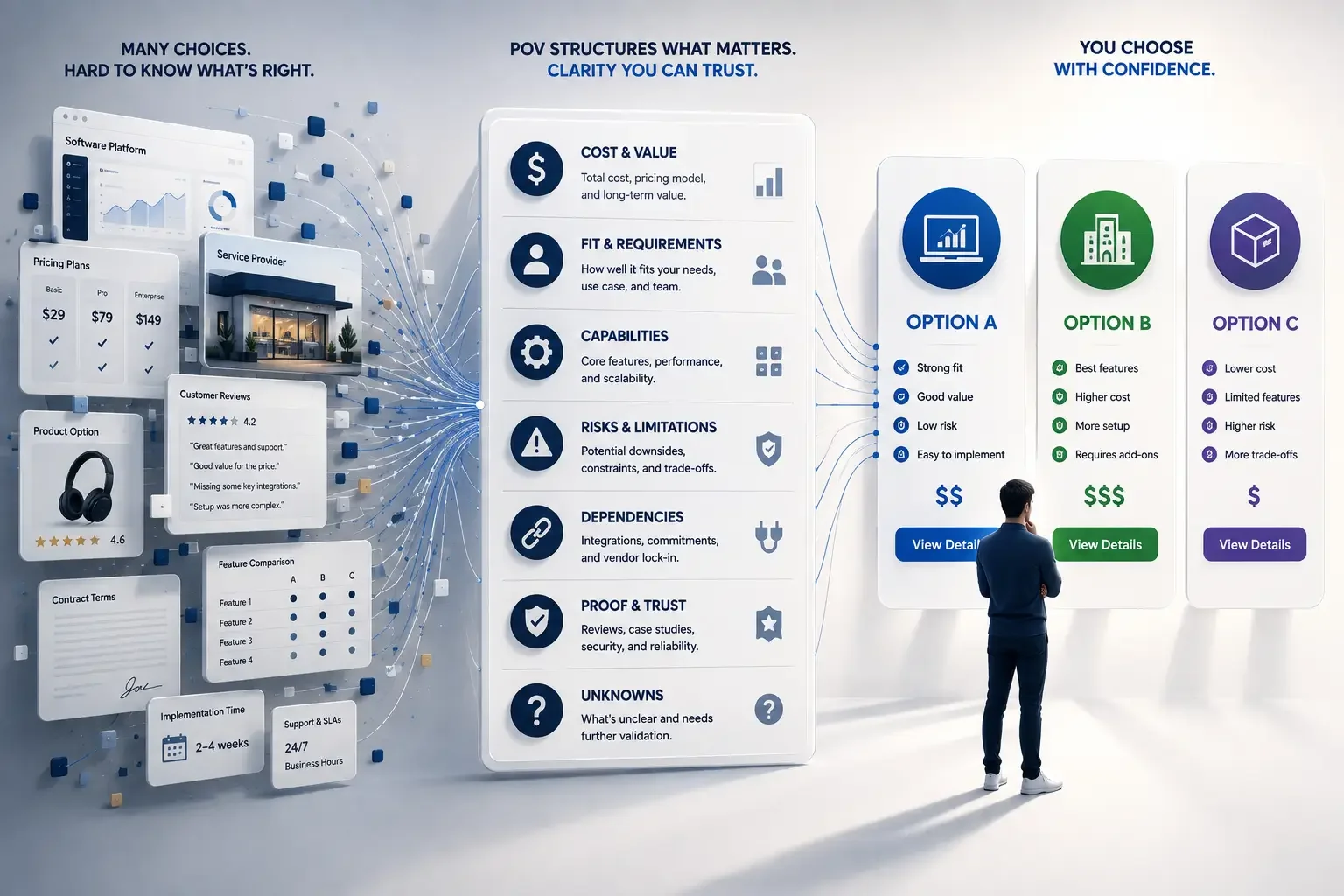
Page One Visibility turns fragmented information about businesses, products, services and platforms into structured Decision Guides that make important commercial decisions easier to understand.
More information does not automatically create more clarity. The difficult part is understanding what the facts mean together, which conditions matter, what remains uncertain and what changes the decision for you.
Decision Index
Understand what actually changes the decision.
A decision is rarely one question. POV separates the material variables so facts, conditions, costs, dependencies and uncertainty can be evaluated together instead of inferred from disconnected information.
The Decision Problem
Information can be accurate and still be insufficient for a decision.
Companies explain what they offer. Search retrieves information. Reviews describe experiences. AI summarizes available sources. But the customer is often still responsible for reconstructing how those facts apply to the decision in front of them.
What Page One Visibility Does
Turn scattered information into a decision you can understand.
POV researches the subject, establishes what can be verified, connects the facts that materially affect the decision and preserves the conditions, boundaries and unknowns that prevent simple answers from becoming misleading ones.
Fragmented Information
Product pages, pricing, documentation, claims, reviews, policies, limitations and third-party evidence.
Decision Structure
Facts are connected to buyer requirements, costs, conditions, dependencies, risks and material unknowns.
Decision Clarity
You can see what applies, what does not, what remains uncertain and what should be verified before choosing.
What POV Evaluates
The category can change. The need for decision clarity does not.
POV is built around consequential decisions rather than a single industry. Software is one decision category, not the definition of Page One Visibility.
Plans, capabilities, operating cost, migration, replacement and retained dependencies.
Scope, fit, commercial model, implementation, limitations and service dependencies.
Performance, switching burden, control, operational requirements and exit risk.
Requirements, cost, tradeoffs, suitability, ownership implications and alternatives.
Where the decision materially benefits from verifiable evidence, explicit conditions and structured comparison.
Page One Visibility Decision Guides
A structured representation of the decision — not another review.
Each Decision Guide is built around the decision that actually needs to be resolved. The information shown depends on what materially changes that decision.
Not every guide requires every decision dimension. Page One Visibility renders the information required by the decision rather than forcing every subject into the same content template.
Decision Standards
Clarity requires knowing what the evidence does — and does not — establish.
Facts remain facts.
Material claims should trace back to an identifiable source or evidence authority.
Conditions remain conditional.
“May require” is not silently converted into “requires.” Buyer state does not become a universal rule.
Unknowns remain visible.
Missing evidence becomes a question or validation requirement, not permission to manufacture certainty.
Negative evidence remains relevant.
Limitations and poor-fit conditions are part of understanding the decision, even when they reduce the likelihood of conversion.
Independence & Commercial Relationships
Compensation does not get a vote in the decision.
Page One Visibility may participate in affiliate, referral, publisher, partner, qualified-lead or other commercial programs. Those relationships sit downstream of the decision intelligence.
If you independently decide to proceed through an eligible relationship, POV may receive compensation. That commercial relationship does not establish factual truth, determine fit or make your decision.
Methodology
Begin with the decision. Then establish what must be known.
POV does not begin by filling a content template. Research starts by defining the decision and identifying the evidence, relationships, conditions and unresolved questions needed to make that decision understandable.
Identify the actual commercial question rather than treating the company or product itself as the topic.
Separate canonical entity facts, independent evidence, inference and unresolved information.
Connect buyer requirements to costs, capabilities, dependencies, conditions and consequences.
Keep material exceptions, limitations and conditional relationships from becoming universal claims.
Identify what the available evidence cannot answer and what could resolve it.
Present the reconstructed decision clearly enough that you can determine what makes sense for your own situation.
Start With the Decision
Understand what matters before you choose.
Explore Page One Visibility Decision Guides and see how fragmented information becomes structured decision clarity.